
Difference: TestTopic022 ( vs. 1)
Revision 12026-03-07 - VictoriAkomar
| Line: 1 to 1 | ||||||||
|---|---|---|---|---|---|---|---|---|
| Added: | ||||||||
| > > |
B.Sc. Agriculture: Details, Eligibility, Fees & Admissions For almost half of India's population, agriculture is their main source of income. This sector accounts for roughly 18% of the country's GDP. Increasing production, cutting expenses, and accomplishing national objectives all depend on developing human potential through research, higher education, and practical training. Education in agriculture is acknowledged as one of the sector's main pillars. B.Sc. is the sought-after foundational undergraduate programme for agriculture-related studies. It equips students with scientific knowledge and practical skills related to farming, crop management, and agricultural systems. The course provides a structured academic pathway for students who wish to contribute meaningfully to modern agriculture and allied sectors.
What Is a B.Sc. Agriculture Course?The B.Sc. agriculture programme is intended to provide a foundation of knowledge that addresses the demands of agriculture. This enables graduates to join the workforce with more specialised and pertinent abilities. The courses enable a comprehensive grasp of the most recent advancements in the subject as well as the application of industry-specific skills. programme is intended to provide a foundation of knowledge that addresses the demands of agriculture. This enables graduates to join the workforce with more specialised and pertinent abilities. The courses enable a comprehensive grasp of the most recent advancements in the subject as well as the application of industry-specific skills.
Overview of B.Sc. Agriculture Course Details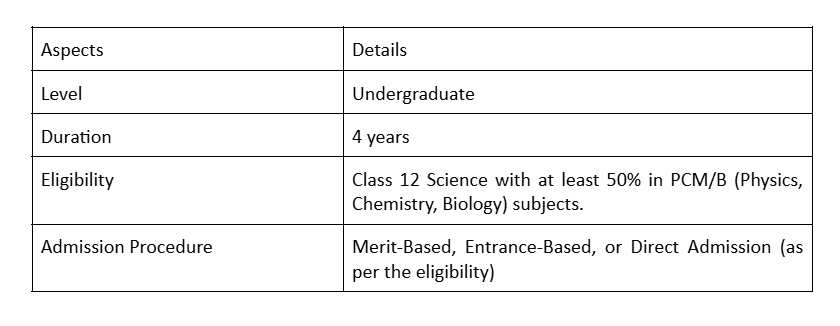
B.Sc. Hons Agriculture vs General B.Sc. AgricultureB.Sc. Hons Agriculture and general B.Sc. Agriculture differ mainly in academic depth and specialisation. The honours programme typically offers a more focused and in-depth study of agricultural sciences. It also put greater emphasis on research, advanced subjects, and practical training. In contrast, a general B.Sc. Agriculture programme offers a broader overview of core agricultural topics. If students are seeking specialised knowledge and deeper subjects prefer the honours option.B.Sc. Hons Agriculture Eligibility CriteriaHere is the eligibility criteria for a B.Sc. (Hons) Agriculture degree in India:
B.Sc. Agriculture Admission Process ExplainedAn educational institution may use three different admission methods to select candidates, ensuring a fair and structured selection process.
Understanding B.Sc. Agriculture FeesCandidates interested in agriculture might think about the B.Sc. Agriculture fees. Tuition, lab fees, hostel or lodging costs, and other incidentals are also included in B.Sc. Agriculture courses. Students may make well-informed decisions on their agricultural careers by being aware of the costs associated with attending college.Choosing B.Sc. Hons Agriculture CollegesHere is what to look for in B.Sc. Hons. Agriculture colleges: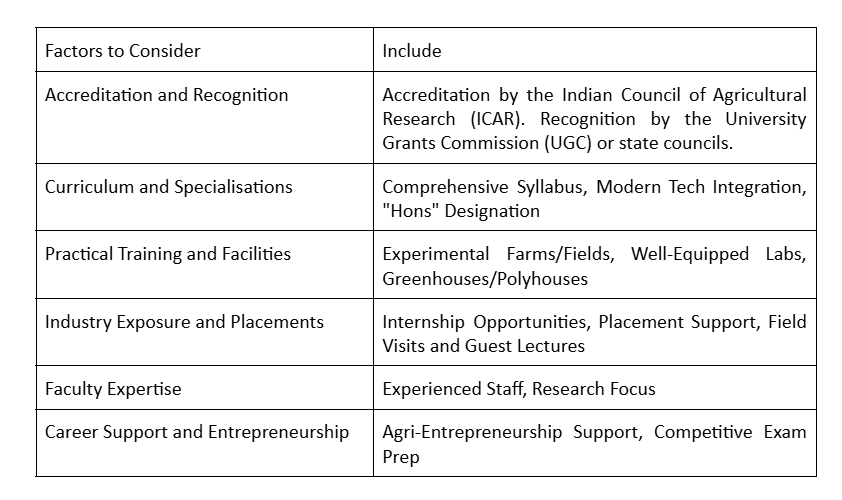
ConclusionChoosing a B.Sc. in Agriculture is a decision that deserves serious thought and research. Students need to gain an understanding of the course structure, the admissions process, and fees. This will really empower them to make the best choices. Agricultural education is not just a trend; it plays a crucial role in fostering innovation, sustainability, and growth in India’s ever-changing agricultural landscape. | |||||||

 Copyright © 2008-2026 by the contributing authors. All material on this collaboration platform is the property of the contributing authors.
 Ideas, requests, problems regarding TWiki? Send feedback